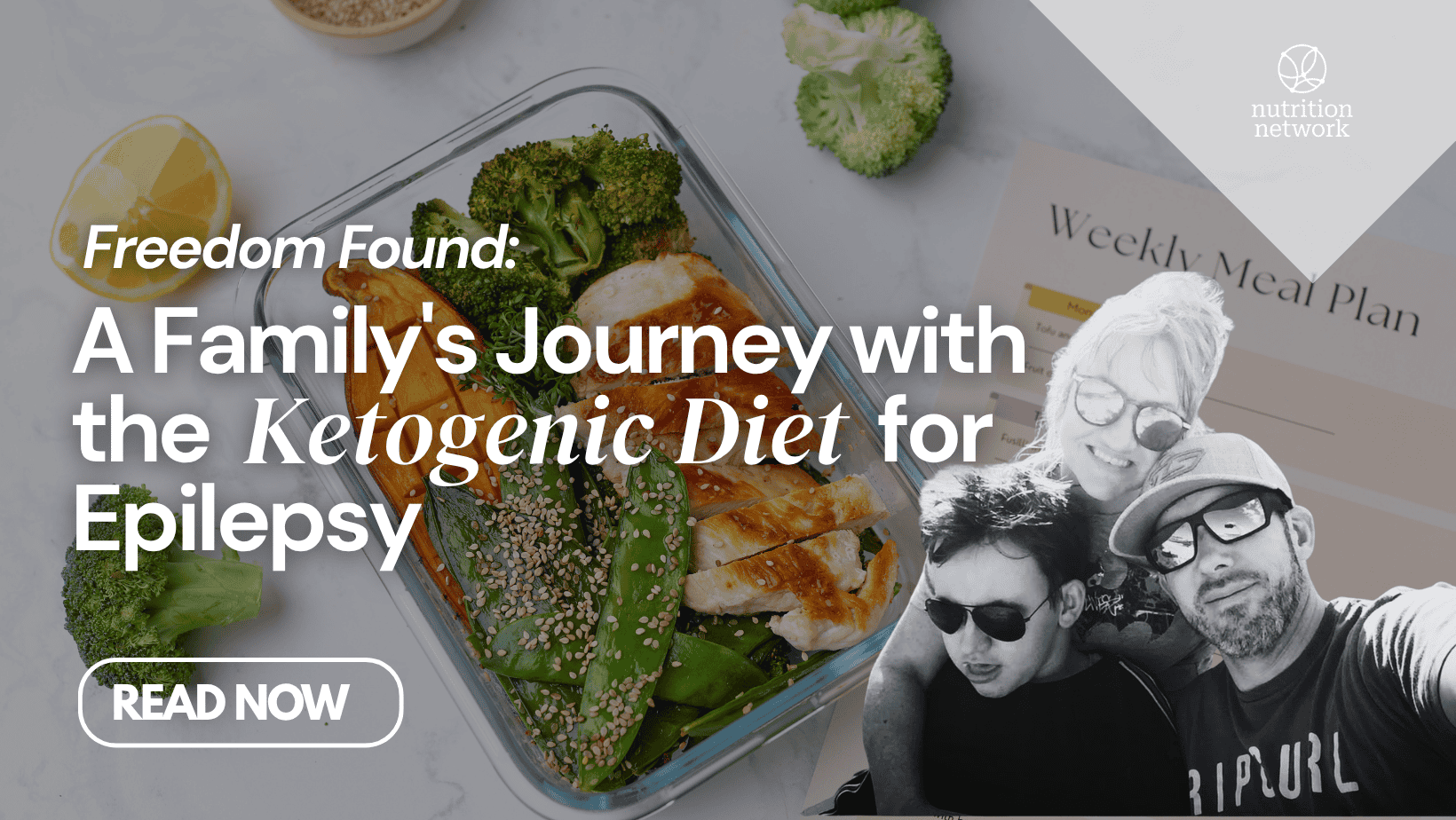
For most parents, mealtimes are one of the small, unremarkable rituals of family life. For Chris and Anita Roland, learning how to feed their son Sam became the thing that gave them their son back. This week, Azza Motara sat down with paediatric dietitian and ketogenic diet expert Kath Megaw, alongside Chris and Anita, to hear how a medically supervised ketogenic diet changed the course of Sam’s epilepsy, and what it actually looks like to live it day to day.
A Diagnosis That Never Quite Arrived
Sam’s early years were marked by uncertainty. He was born without obvious complications, but his parents soon noticed a generalised muscle weakness that, to this day, remains undiagnosed. Then came the seizures, and not the manageable kind. Sam experienced status epilepticus, prolonged seizures that can run over an hour, sometimes longer, each one a genuine medical emergency. Chris and Anita describe those years as harrowing: repeated trips to the emergency room, days spent in high care and a son whose energy would run out almost as soon as it began, like a battery that never held its charge.
By the time families like the Rowlands find their way to Kath, they’ve usually already been through an exhausting cycle of research, medication trials and hospital admissions. Kath is candid about what that first consultation involves. She lays out plainly what the diet demands: there’s no eighty-twenty flexibility where a family can follow it most of the time and improvise the rest. It’s a significant shift in how a household eats and she doesn’t pretend otherwise. But as Chris pointed out to her, and she now shares with every family she meets, the difficulty of changing a diet is nothing next to the alternative of watching your child in status epilepticus in an ICU.
Carrying It as a Family
Anita’s reflections added another layer to the conversation, one that’s often missing from clinical accounts of paediatric illness. She described the disorientation of finding herself on a disability journey she never anticipated and the isolation that can come with it. What stayed with her was a question an occupational therapist once asked, not about Sam, but about her and Chris: how are you two doing, as individuals and as a couple, in the middle of all this?
That question reframed things. The Rowlands came to understand Sam’s care as something that needed input from multiple directions at once, not medication alone.Recognising that medication wasn’t solving everything pushed them to look further, and the ketogenic diet became part of the picture alongside the pharmaceuticals rather than instead of them, a combination Anita says has been the most powerful part of Sam’s story.
From Last Resort to First-Line Therapy
One of the more striking parts of the conversation was Kath’s account of how the ketogenic diet’s reputation has shifted, from a treatment doctors turn to when nothing else has worked, to something that belongs much earlier in the conversation. She credits a lot of that change to education. Years ago, she helped raise the funds to send a resistant neurologist to an international ketogenic conference and watching that specialist come back genuinely informed, rather than fearful, changed the tenor of every referral since.
For some children, Kath explained, the diet isn’t a last resort at all. Certain metabolic conditions leave the body unable to break down carbohydrate for fuel, which makes fat, and therefore a ketogenic approach, the only real option for feeding the brain. For others, including infantile spasms, it belongs firmly in the first or second line of treatment, not the third or fourth. She also pushed back on the idea that seizure count alone tells the whole story. Clinicians and families, she said, should be watching recovery time, seizure severity and duration and everyday functioning, not just whether seizures have stopped altogether. Even when breakthrough seizures occur, the diet may still be delivering real neuroprotective benefit that builds cumulatively over time.
How One Family’s Kitchen Changed
For the Rowlands, adapting to Sam’s needs meant more than adjusting his plate. Sam has allergies to both eggs and dairy, which narrowed the field considerably. Kath and the family built his diet around pumpkin, salmon, macadamia nut butter, avocado and MCT oil, and from those unlikely building blocks came genuine creativity, including a birthday cake made from marrow, xylitol and cocoa that Sam adores (the other children at his school party, Anita admits with a laugh, were considerably less convinced).
Chris had his own parallel journey. Long before Sam’s diagnosis, he’d started a lower carbohydrate approach to manage chronic migraines and the change was dramatic enough that he no longer needed blood tests to know when he’d strayed off course. He has stayed with this way of eating for more than a decade.
Beyond seizure control, the family has noticed something else worth naming: Sam’s general health has improved markedly. Where he once caught every cold going and took ages to recover, he’s now, in his parents’ words, a strong and robust young man.
A Toolbox, Not a Template
Kath’s philosophy extends across the age range she treats, from newborns in neonatal intensive care to teenagers negotiating their own autonomy. The diet’s effectiveness doesn’t change with age, she explained, but compliance and approach absolutely do. She described working with a teenage patient who flatly refused the diet her mother and neurologist wanted for her. Rather than push, Kath offered her a doorway instead of an ultimatum: start with a few added foods and some MCT oil, keep the pasta for now. Two years later, after a difficult stretch of hospital admissions, that same young woman called Kath herself and asked to try a version of the diet on her own terms. Today she’s on a classical ketogenic diet and seizure free.
That flexibility is deliberate. Kath keeps what she calls a toolbox of approaches, from the classical ketogenic diet to a modified Atkins protocol with MCT oil, so that families and patients can find a version that fits their life rather than abandoning the diet altogether. Meeting a patient where they are, she said, is often what makes long-term success possible.
Getting Their Boy Back
For the Rowlands, the clearest sign of change wasn’t a single lab result but their son himself. Seizures that once meant hours in status now resolve in thirty seconds. An L-carnitine supplement, added alongside the ketogenic diet, transformed Sam’s energy so completely that a boy who once needed a nap every fifteen minutes could suddenly get through a full day. Just as significantly, working with their paediatrician to bring Sam’s medication down to a sub-therapeutic dose, something only possible because the diet was doing so much of the work, let his personality re-emerge from underneath years of heavy sedation.
“We’ve been given back our freedom,” Anita said. “And Sam has been given back his freedom to live his life fully.” It’s hard to overstate what that means for a family who once counted the hospital nursing staff among their closest acquaintances.
What Kath Wants Every Family and Clinician to Know
Asked what she’d want practitioners and families to take from Sam’s story, Kath returned to a theme that ran through the entire conversation: individuality. No single food or ratio works the same way for every child, and getting to know a patient, not just their chart, is what makes the diet succeed long term. She and her team check in with families regularly, by design, because that ongoing relationship is where the real adjustments happen.
Her clearest message, though, was a caution. This is a medical diet, and it needs medical supervision. Bloods and labs need monitoring, growth needs protecting and the diet’s other effects on the body need a trained eye watching for them throughout.
If Sam’s story resonates with you, or you have your own experience of how a low-carbohydrate or ketogenic approach has changed your family’s life, we’d love to hear it, reach out to us through our social media. And if you’re a clinician working with epilepsy in your practice, Kath Megaw’s in-depth lecture on the ketogenic diet in paediatric epilepsy, part of our current training, The Next Generation: Child and Family Health, is available now.